
Essential Auto Services Every Used Car Buyer Must Schedule
The moment the keys to a newly purchased pre-owned car are placed in your hand, a quiet shift takes place. The excitement of test drives, price negotiations, and title transfers fades, leaving behind an inescapable reality: you have officially taken custody of an unfamiliar machine with a past. Regardless of how immaculate the paint looks under bright afternoon sunlight or how smoothly the engine purred during a ten-minute neighborhood loop, every pre-owned automobile carries mechanical unknowns. Gaskets have experienced countless heat cycles, suspension bushings have endured thousands of potholes, and fluids have quietly oxidized in dark sumps and lines.
Driving a recently purchased vehicle home is not the conclusion of the buying journey; it is merely the first operational phase. The decisions you make during the initial four weeks of ownership will directly determine whether your new acquisition delivers years of reliable service or quickly becomes a drain on your bank account. Establishing a firm mechanical baseline is the single most effective way to eliminate uncertainty, safeguard your financial investment, and guarantee road safety. Rather than waiting for dashboard warning lights to blink on or strange vibrations to rattle the cabin, proactive drivers take deliberate ownership of their vehicle’s maintenance timeline right from the start.
Decode Vehicle Health with an Independent Technical Audit

Even the cleanest used vehicles frequently mask deferred maintenance. The inventory displays arranged by local used auto dealers look pristine, but forecourt preparation is primarily focused on cosmetic presentation rather than deep mechanical validation. Dealership inspections frequently confirm little more than legal roadworthiness—verifying that tires have minimum legal tread, brake pads meet basic thickness thresholds, and headlamps illuminate. Subtler issues like weeping transmission seals, degraded differential fluid, or micro-cracks in serpentine belts are regularly ignored to maintain profit margins.
Arranging an immediate, independent mechanical assessment at a trusted service facility allows an objective third party to dissect the car’s current state. This baseline review should be treated as an educational inventory of the entire vehicle. A seasoned technician with a diagnostic scan tool can uncover stored trouble codes that have not yet triggered a visual dashboard warning, check freeze-frame sensor data to verify engine operating temperatures, and physically manipulate suspension linkages with a pry bar to check for hidden bushing deflection.
To ensure nothing is overlooked, provide your technician with a focused punch list:
- Fluid Condition Analysis: Assess the color, clarity, and smell of the brake fluid, engine coolant, transmission oil, and differential gear oil. Burnt smells or dark, opaque coloring signify urgent service needs.
- Charging and Starting Systems: Conduct a battery load test, record alternator output voltage under maximum electrical load, and check starter motor draw to avoid being stranded unexpectedly.
- Belt and Hose Integrity: Inspect serpentine drive belts for rib cracking, tensioner flutter, and edge fraying. Squeeze radiator hoses to test for interior wall softening, embrittlement, or heat-induced hardening.
- Underside Leak Mapping: Clean the lower engine casing and transmission belly with degreaser so that fresh oil drips, coolant weeping, or axle boot tears can be spotted immediately.
Once this technical evaluation is complete, bundle the necessary repairs alongside scheduled auto services that establish your ownership starting point. Replacing the engine oil and filter immediately, installing a new engine air filter, and refreshing spark plugs eliminates previous maintenance blind spots. From this moment onward, you are no longer guessing when components were last touched; you possess a documented, clean baseline that you can monitor and maintain with confidence.
Uncover Past Trauma Through Accident Forensics and Legal Due Diligence
Every pre-owned car carries a paper trail, but modern vehicle history reports are far from infallible. Data aggregators only report what has been officially submitted by participating repair shops, insurance companies, or law enforcement registries. If an accident went through private settlements or off-the-books repairs, the digital vehicle history might read completely clean while the sheet metal tells an entirely different story. Dissecting the physical signs of previous crashes is crucial for understanding whether the vehicle retains its original structural crash-worthiness.
Severe highway collisions frequently originate from reckless incidents or driving under the influence. In these complex scenarios, insurance negotiations or personal injury disputes handled by a DWI attorney often result in long delays, contentious vehicle evaluations, or budget-restricted repair authorizations. When vehicles caught up in severe legal and insurance battles are repaired under financial pressure, corners are frequently cut. Parts may be sourced from junkyards without verification, and structural mounting points may be patched together rather than properly replaced.
Spotting previous incident repairs requires keen observation and a few straightforward diagnostic practices:
- Fastener and Bolt Heads: Examine the mounting bolts along the front fenders under the hood, door hinges, and trunk lids. Scratched factory paint on these bolt heads indicates that panels were unbolted, realigned, or entirely replaced following impact.
- Overspray and Masking Lines: Run your bare fingertips along the rubber door gaskets, window edges, and wheel well lips. A rough, sandy feel or subtle paint ridges indicate paint refinishing and masking tape boundaries.
- Inner Fender and Core Support Welds: Compare the spot welds on the left side of the engine bay to those on the right side. Factory spot welds are uniform, indented, and spaced precisely by robotics. Irregular, hand-applied welds or excessive seam sealer point toward repaired front-end trauma.
- Trunk Well and Spare Tire Tub Inspection: Pull out the spare tire and sound-deadening mats to check the floor metal. Ripple marks, uneven seams, or pooling water signify a past rear-end shunt that pushed the rear bumper beam inward.
Verifying the structural integrity of past insurance collision repair work is about personal preservation. Factory crumple zones are specifically engineered to deform at precise rates during an impact, routing violent deceleration forces around the cabin. If an unrecorded repair utilized improper heat-straightening techniques or cheap aftermarket structural components, those safety systems may fail catastrophically in a future incident. Call an expert for insurance collision repair.
Evaluate Chassis Geometry and Exterior Paneling
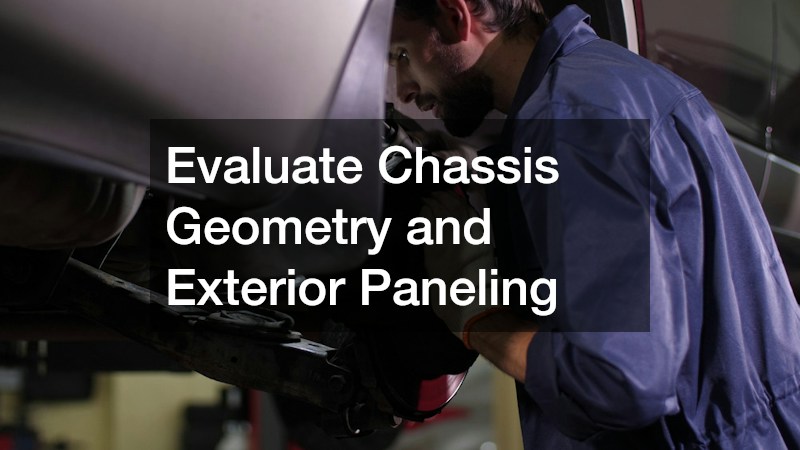
Once you are confident in the vehicle’s documented history, attention must turn to the structural foundation underneath. A vehicle’s frame or unibody structure functions as the skeleton for the entire mechanical assembly. Over years of operation, aggressive speed bumps, curb strikes, potholes, and winter road salt can degrade chassis integrity. On classic rear-engine vehicles as well as modern unibody cars, rust and metal fatigue are insidious enemies that quietly undermine structural rigidity.
If your preliminary underside inspection exposes buckled frame rails, kinked floor pans, or shifted subframe mounts, the car must be placed on a computerized measurement bench. A specialized collision repair workshop utilizes lasers and optical targets mapped against factory blueprints to confirm that the suspension mounting points sit within millimeters of original factory specifications. A chassis that sits slightly out of square will cause perpetual handling imbalances, accelerate tire destruction, and place dangerous twisting loads on the drivetrain.
Beyond the inner structure, exterior sheet metal and exterior panels demand thorough inspection and mechanical adjustment:
- Door and Hatch Clearances: Walk around the car and visually measure the spacing between doors, fenders, and quarter panels. Uneven gaps that taper from wide to narrow often reveal subtle unibody twisting or worn hinge assemblies.
- Corrosion Mitigation: Look for bubbling paint around wheel arches, rocker panels, and floor pans. Surface rust must be ground back, converted chemically, and sealed before it migrates into deep, structural perforation.
- Water Management Passages: Clear leaves and debris from the cowl drain below the windshield, sunroof channels, and lower door drain slits. Blocked water exits back up quickly, flooding electrical modules and cabin carpets.
Addressing cosmetic dings, panel misalignments, and worn hinges with a skilled auto body repair specialist restores the visual character and weather sealing of the car. When doors latch with a solid, satisfying thud rather than a metal-on-metal scrape, cabin drafts disappear, interior wind noise drops dramatically at highway speeds, and delicate interior carpeting remains dry through heavy rainstorms.
Overhaul Running Gear, Stopping Systems, and Steering Response

No mechanical assembly on a motor vehicle outranks the braking system in terms of passenger safety. While engines can run poorly without causing immediate bodily injury, a degraded braking setup turns any car into an uncontrollable hazard. Many used car owners focus exclusively on the remaining thickness of their brake pads, completely neglecting the hydraulic fluid and mechanical hardware responsible for transferring pedal effort to the wheels.
Brake fluid is hygroscopic, meaning it continuously absorbs airborne moisture through atmospheric vents and rubber flex lines. Over three to five years, this absorbed water drastically reduces the fluid’s boiling threshold and sparks internal corrosion across the metal caliper pistons and ABS pump valves. Scheduling a comprehensive brake repair should encompass far more than sliding fresh friction material into place. It demands a full system bleed with fresh fluid, checking rotor runout with a dial gauge, cleaning sliding pins of baked grease, and replacing aged rubber hoses that can swell internally and restrict fluid return.
Simultaneously, the steering assembly and suspension links must be returned to factory specification to preserve vehicle stability and prevent erratic highway tracking:
- Rubber Bushing Assessment: Check control arm bushings, sway bar end links, and subframe mounts for tearing, cracking, or grease loss. Degraded rubber permits wheels to shift back and forth under braking and acceleration.
- Steering Play Checks: With the front wheels elevated, firmly grasp each tire at the nine-o’clock and three-o’clock positions, rocking it back and forth to feel for loose tie-rod ends or worn steering rack teeth.
- Struts and Dampers: Check damper bodies for weeping hydraulic oil and push down on vehicle corners to confirm oscillations settle instantly without bouncing.
Once all worn friction components and loosened ball joints are renewed, taking the car in for a computerized four-wheel alignment is mandatory. Precise adjustments to caster, camber, and toe angles ensure that tire contact patches sit evenly against the road surface.
Restore Climate Control Efficiency and Cabin Sanitation
The interior of a pre-owned vehicle is where you will spend hundreds of hours, making air quality, thermal management, and hygiene essential to your driving experience. Far too many car buyers accept weak airflow or lukewarm defrosters as quirks of an older automobile, failing to realize that climate control is fundamentally a safety asset. Rapidly clearing a fogged windshield on a freezing, rain-soaked morning is just as vital for road safety as functioning headlights or reliable wipers.
A vehicle’s climate system degrades slowly, with refrigerant molecules escaping microscopic pores in rubber seals, drying O-rings, and road-grit-blasted condensers. Bringing the system back up to peak cooling and rapid dehumidification typically requires a targeted car AC repair session. A certified technician can pull a deep vacuum on the refrigerant circuit to vaporize moisture, perform a pressure-decay test to isolate hairline leaks, inject fluorescent UV dye, and charge the system with the exact weight of refrigerant specified on the under-hood tag.
Simultaneously, the biological and tactile environment of the cabin should be stripped clean of previous owners’ residue:
- Air Filtration and Evaporator Sanitization: Remove the neglected cabin filter and spray an enzymatic cleaner directly across the air-conditioning evaporator core to kill mold, mildew, and bacteria that generate stale scents.
- Deep Hot-Water Extraction: Shampoo fabric upholstery, floor carpets, and trunk mats using commercial hot-water extraction equipment to draw out ground-in mud, spilled beverages, and embedded dander.
- Surface Hydration and UV Shielding: Treat sun-baked vinyl dashboards, brittle door cards, and leather seating surfaces with pH-balanced conditioners to halt cracking and restore original suppleness.
- Glass Decontamination: Strip oily off-gassing haze and smoker residue from the inner windshield with an alcohol-based glass cleaner to eliminate dangerous nighttime glare from oncoming headlights.
Investing in thorough, multi-stage auto detailing transforms the ownership experience from feeling like you are operating a stranger’s cast-off car to enjoying a clean, fresh, personalized machine. Eliminating grit from seat rails, removing sticky film from the steering wheel rim, and dressing interior surfaces returns tactile satisfaction to every commute.
Taking Confident Ownership of the Road Ahead

Purchasing a pre-owned car will always carry an element of the unknown, but that uncertainty does not have to turn into an expensive gamble. Reliability is not a lucky roll of the dice; it is a calculated mechanical state achieved through intentional maintenance, thorough diagnostics, and respect for mechanical wear limits. By systematically checking the chassis, rehabilitating vital stopping and steering components, baselining core fluids, and sanitizing the cabin environment, you systematically strip away the risks left behind by previous drivers.